Can You Find All Five Differences in This Picture Puzzle
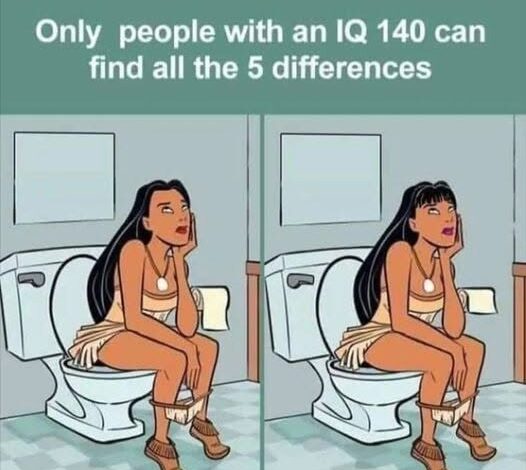
# Test: Only a Person with an IQ of 140 Can Find the 5 Differences…
You’ve probably seen the headline before—bold, teasing, and impossible to ignore:
**“Only a person with an IQ of 140 can find the 5 differences.”**
It pops up on social media feeds, puzzle websites, and group chats. Two nearly identical images appear side by side, and the challenge is simple: *spot the five differences*. Yet minutes pass, your eyes dart back and forth, and suddenly the task feels anything but simple.
Is it really a test of intelligence? Or is something else at play?
* Why “spot the difference” tests are so popular
* Common traps that make you miss obvious differences
* How to improve your observation skills
* Why IQ has little to do with it (despite the headline)
By the end, you’ll understand why these puzzles are so captivating—and why failing to spot all five differences says nothing negative about you.
## The Allure of the “High IQ” Challenge
Let’s be honest: the phrase *“only a person with an IQ of 140”* is designed to hook you.
It does three powerful things at once:
Humans are naturally drawn to challenges that test mental ability—especially when framed as rare or elite. Even people who know the claim is exaggerated still feel compelled to try.
## What Is an IQ of 140, Really?
Before going further, let’s clarify something important.
An IQ score of 140 is considered **very high**, typically placing someone in the top 0.5–1% of the population. It’s associated with advanced reasoning, problem-solving, and abstract thinking.
👉 **Spot-the-difference puzzles do not measure IQ.**
“Find the differences” challenges rely primarily on **visual perception and attention**, not intelligence in the traditional sense.
These are cognitive skills, yes—but they’re **specific**, and they vary widely depending on mood, fatigue, lighting, and even screen size.
A tired person with a high IQ may struggle.
A relaxed person with average IQ may excel.
## Why These Tests Feel So Hard
If the task is simple—just compare two images—why does it feel so difficult?
Because your brain isn’t designed to notice small differences automatically.
This helps you function in the real world—but it works *against* you in observation puzzles.
When two images look nearly identical, your brain assumes:
> “I’ve seen this already. It’s the same.”
That assumption is the puzzle’s biggest obstacle.
There’s a well-documented phenomenon called **change blindness**.
It refers to our inability to notice small changes in visual scenes, especially when:
Even trained observers can miss large changes if they occur outside focused attention.
## Why the “5 Differences” Format Is So Effective
* Fewer than five = too easy
* Encourages sharing (“Can you find them all?”)
It’s just enough to frustrate without causing people to quit immediately.
Once you know what to look for, patterns emerge.
Here are the most common tricks used in these puzzles:
Your brain often ignores color shifts if shape remains the same.
These are often overlooked because your brain “fills in” what it expects to be there.
If proportions remain similar, the difference slips by.
* Angle changed just enough to be confusing
Motionless images with minimal shifts are especially tricky.
Your brain reads patterns as a whole, not as individual elements.
Many versions of these puzzles include a time limit:
> “Find all 5 differences in 10 seconds!”
Ironically, the people who succeed fastest often *ignore* the time limit.
## Why Some People Are Better at These Tests
If it’s not IQ, what makes someone good at these puzzles?
These advantages have little to do with intelligence—and everything to do with practice and context.
## The Role of Fatigue and Focus
* After staring at screens all day
The difference in performance can be dramatic.
This alone proves these puzzles are not fixed measures of ability.
## Why the Internet Loves These Tests
Attaching IQ claims to puzzles creates an illusion of scientific legitimacy.
A single image puzzle cannot do that.
The IQ claim is **marketing**, not measurement.
## How to Actually Improve at Spot-the-Difference Puzzles
If you want to get better (for fun or bragging rights), here are proven strategies.
### 2. Compare One Element at a Time
Don’t try to see everything at once.
Your brain notices different details at different scales.
Stepping away for 30 seconds can reset your perception.
## Why Missing Differences Feels So Frustrating
There’s a psychological reason frustration builds quickly.
This creates cognitive tension—similar to an unresolved song lyric or unfinished sentence.
That tension keeps you engaged longer than success would.
## Are These Tests Good for Your Brain?
## The Social Side of These Puzzles
This social aspect increases enjoyment and reduces pressure.
## The Danger of Taking the Headline Seriously
The only real problem with “IQ 140” headlines is when people internalize them.
* Your brain works efficiently, not obsessively
## Why Intelligence Is More Than Visual Detail
## A Healthier Way to Frame the Challenge
> “Can you spot all 5 differences?”
## Why You’ll Keep Clicking These Tests Anyway
Even knowing all this, you’ll probably still click the next one.
## Final Thoughts: It’s a Game, Not a Judgment
“Only a person with an IQ of 140 can find the 5 differences” is a clever headline—not a scientific truth.