8 Year Old Girl Who Lost Both Legs Dreams of Dancing Again Her Classmates Grant Her Wish but the Music Suddenly Stops
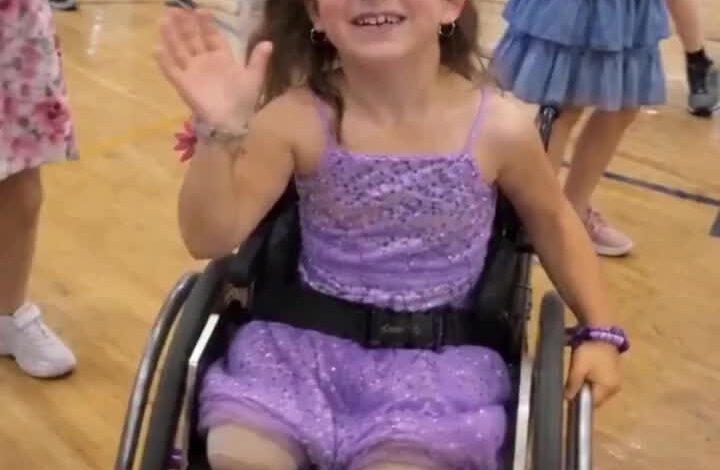
Eighteen months after the accident that cost my daughter both her legs, she finally danced again. But what happened during her school performance left me screaming.
The man shoved Chloe hard enough to knock her out of the wheelchair.
I screamed.
For one second, I thought he'd attacked my daughter.
Then something crashed onto the floor exactly where she'd been sitting.
A metal lighting rig.
One of the tall portable stands beside the dance floor had tipped over.
The crossbar slammed down so hard that one of the stage lights shattered.
Glass scattered across the gym floor.
Parents screamed.
Children started crying.
And the school employee who had knocked Chloe down was lying on top of her, shielding her with his body.
I stopped moving.
My brain could not catch up.
Seconds earlier, I'd been trying to fight him because he'd grabbed me.
Now he was curled over my daughter while broken metal rested inches from his back.
"Chloe!"
He rolled away.
I dropped beside her.
She was crying now.
Not because she was badly hurt.
Because everyone else was screaming.
"Mommy!"
"I'm here."
I pulled her against me.
Her purple dress was twisted around her.
One ribbon had fallen out of her hair.
Her wheelchair was on its side.
I ran my hands over her arms, shoulders, and head.
"Does anything hurt?"
"My elbow."
"Anywhere else?"
She shook her head.
The employee sat up slowly.
His forearm was injured.
One of the teachers shouted, "Call 911!"
Someone already had.
My name is Rachel. Chloe is my daughter.
And before that day, I thought the most frightening moment of my life had already happened 18 months earlier.
I was wrong.
The accident that changed Chloe's life happened on a Tuesday afternoon.
A driver ran a red light.
Our car was struck on the passenger side.
I remember the sound more than anything.
Metal. Glass. Then silence.
Chloe was eight by then.
She survived.
That sentence is important.
She survived.
But both of her legs were so badly injured that doctors couldn't save them.
One was amputated above the knee.
The other below.
The first few months afterward are still difficult for me to describe.
Pain. Surgeries. Rehabilitation.
Learning how to transfer from a bed to a wheelchair.
Learning how to bathe differently.
Learning how to answer strangers who stared.
Before the accident, Chloe danced constantly.
Everywhere.
She had taken beginner dance classes since she was five.
Nothing serious.
She wasn't some child prodigy.
She just loved music.
If a song came on in the grocery store, she'd start moving.
If I played music while cooking, she'd spin through the kitchen until I yelled, "Hot stove!"
Then she'd dance three feet farther away.
After the accident, music disappeared from our house.
Not because I banned it.
Because Chloe stopped asking for it.
One afternoon, a few weeks after she came home, she looked at the mirror in her bedroom.
Then said, "Can you take that down?"
I knew why.
Still, I asked, "Why?"
She stared at her lap.
"I don't like looking at myself anymore."
I made it to the hallway before I started crying.
The mirror came down.
I hated myself for taking it down.
Then hated myself for thinking maybe I should have refused.
Grief makes you second-guess every small decision.
Should I push her?
Should I leave her alone?
Should I say legs don't define her?
Would that sound ridiculous coming from someone who still had both of mine?
So I learned to listen more.
Chloe eventually returned to school.
Her classmates were mostly wonderful.
Kids can be cruel.
They can also adapt faster than adults.
After the first week, her wheelchair stopped being the most interesting thing about her.
It became Chloe's chair.
Sometimes a classmate held a door.
Sometimes she yelled, "I can do it!"
Sometimes she needed help.
Sometimes she didn't.
Then came dance.
During recess, a few girls would play music through a teacher's speaker.
Chloe watched.
She pretended not to.
But I saw it when I volunteered at school.
She'd sit near the edge of the playground.
Smile. Clap. Never join.
In early October, her teacher, Ms. Ramirez, asked me to stay after pickup.
She looked nervous.
"Can I ask you something without you immediately saying no?"
"That's an alarming opening."
She smiled.
"The class is doing a dance for the fall festival."
I already knew where this was going.
"The kids want Chloe in it."
I didn't answer.
Ms. Ramirez quickly added, "Only if she wants to."
"Did they ask her?"
"Not yet."
"Why not?"
"Because I wanted to ask you first."
I appreciated that.
She told me the children had been planning a routine.
One boy, Mason, suggested Chloe could dance in her wheelchair.
Another girl said, "Why don't we make the dance fit everyone instead of making Chloe fit the dance?"
That sentence came from an eight-year-old.
I still think about it.
I asked Chloe that evening.
At first, she stared at me.
"Me?"
"Only if you want."
"But I can't dance."
I sat beside her.
"You can't dance the way you used to."
Her eyes filled.
I hated myself for saying it.
Then I continued, "That doesn't mean you can't dance."
She didn't answer.
The next morning, she said, "I want to try."
That became six weeks of chaos.
Music returned to our house.
Chloe practiced turns in her wheelchair.
She learned to spin without getting dizzy.
The class changed formations so some children danced standing and others moved around her.
One boy used his arms to mirror Chloe's movements.
Another girl sat in a chair for part of the routine, so Chloe wasn't the only person dancing from a seated position.
It wasn't perfect. It didn't need to be.
Chloe laughed again. Really laughed.
She chose a sparkly purple dress.
Matching ribbons.
Silver shoes even though she wouldn't wear them.
She wanted them attached to the front of her chair because, as she put it, "dancers need shoes."
I didn't argue.
On the morning of the festival, she asked me to put the mirror back up.
I froze.
"Are you sure?"
She nodded.
So I hung it. Not exactly where it had been.
A little lower.
She looked at herself in the dress.
Then said, "I look fancy."
I cried in the bathroom where she couldn't see me.
The school gym was packed that afternoon.
Parents sat on folding chairs.
Kids ran everywhere.
The class performed near the center of the gym.
Portable lights had been brought in because the regular gym lighting was terrible for performances.
There were speakers.
Cables were taped to the floor, and a backdrop.
Everything looked more professional than I expected.
The music started, Chloe rolled onto the floor, and the children moved around her.
She turned, clapped, spun, and raised both arms.
She was laughing so hard she missed one cue.
Nobody cared.
I filmed everything.
Then the music stopped.
Not faded. Stopped.
A metallic cracking sound came from somewhere to my left.
Then another.
People looked up.
One teacher screamed, "Move!"
I dropped my phone.
I saw one of the lighting stands leaning.
Slowly at first. Then faster.
Toward the children. Toward Chloe.
I ran.
That was when someone grabbed me around the waist.
I fought him.
"Let me go!"
He released me. Then sprinted.
I recognized him vaguely.
A school facilities employee.
His name, I later learned, was Marcus.
He reached Chloe before I did.
He shoved her sideways out of the wheelchair. Then covered her.
The lighting rig crashed down.
If Chloe had still been sitting upright, the metal crossbar would've hit her.
Instead, it smashed into the chair.
Bent one wheel.
Destroyed the armrest.
And missed Chloe by less than a foot.
Paramedics arrived quickly.
Chloe had a bruised elbow and a small scrape on her shoulder.
Marcus needed stitches in his forearm.
One child was injured by flying plastic from a light cover.
No one suffered a major injury.
That sentence still feels miraculous.
At the hospital, Chloe kept asking about her wheelchair.
"Is it broken?"
"Yes."
Her face crumpled.
"My dance chair."
I almost laughed from relief.
She had nearly been hurt by a lighting rig and was angry about missing the rest of the dance.
Ms. Ramirez arrived about an hour later.
She was crying.
"I'm so sorry."
I hugged her.
Then the principal arrived.
Then someone from the district.
Then, eventually, the questions started.
What happened?
Why did the stand fall?
Was it secured?
Who set it up?
I assumed it had simply been a terrible accident.
It wasn't quite that simple.
The stand had been placed near the edge of the performance area.
One of its stabilizing legs had been partly folded inward to make room for a row of chairs.
Someone had also run an extension cable too tightly around the base.
During the performance, another staff member moved a speaker cart.
The cart caught the cable. The cable pulled.
The already unstable stand tipped.
There was no villain.
No one had deliberately created danger.
Just several small decisions that lined up badly.
That almost made me angrier.
Because each decision had probably seemed harmless.
Then suddenly hundreds of pounds of equipment were falling toward children.
Marcus had noticed something was wrong before the teacher shouted.
He told me later he'd heard the base scrape.
He worked in facilities.
He knew that sound was wrong.
When he saw the stand start to lean, he tried to stop me first because I was running directly into its path.
Then he realized he couldn't reach both of us in time.
Once he'd pulled me out of its path, he let me go and went for Chloe.
I asked him, "Why her?"
We were sitting in the hospital hallway.
His arm was bandaged.
He looked confused.
"What do you mean?"
"There were other kids."
"I know."
"Why Chloe?"
He hesitated.
Then said, "Because the others were moving."
That answer hurt.
Not because it was cruel.
Because it was true.
When the teacher yelled, most of the children could scatter.
Chloe couldn't.
Her wheelchair needed space to turn.
She couldn't simply jump sideways.
Marcus saw that in one second. So he made the choice for her.
He pushed her out of the chair.
I said, "You could've hurt her."
"I know."
"You did hurt her elbow."
"I know."
"But…"
My voice broke.
He looked down.
I said, "You saved her."
He shook his head.
"I moved her."
"Marcus."
He looked at me.
"Thank you."
He nodded once.
Then said, "She's tough."
I laughed.
"She's going to be unbearable when she hears you said that."
The school canceled the rest of the festival.
The district opened a safety review.
All portable staging and lighting equipment was removed until inspections were completed.
The company that provided some of the equipment also reviewed its setup procedures.
I cared about all of that.
But Chloe cared about one thing.
The dance.
Two days later, lying on the couch with her bruised elbow, she said, "We didn't finish."
I looked at her.
"The lighting rig almost fell on you."
"I know."
"You went to the hospital."
"I know."
"And you're worried about the dance?"
"We practiced six weeks."
Fair.
Then she said, "Can we do it again?"
I wanted to say no.
Every part of my body wanted to say no.
I imagined another accident.
Another ambulance. Another phone call.
Then I remembered the mirror.
I remembered how long it had taken for music to come back into our house.
I asked, "Do you want to?"
"Yes."
So I called Ms. Ramirez.
She was quiet for a second.
Then said, "The kids have been asking the same thing."
A week later, the school restaged the performance.
Very differently.
No portable lighting rigs. No unnecessary cables. No fancy backdrop.
Just the regular gym lights and one speaker secured against the wall.
I appreciated the lack of ambition.
The district also arranged for Chloe to receive a temporary wheelchair while hers was repaired.
But she hated it.
On the day of the second performance, the gym was full again.
Fuller than before.
Word had spread.
I worried that people were coming because they wanted to see the "brave little amputee girl."
I didn't want that for her.
But Chloe didn't seem bothered.
She was focused on the dance.
Then, just before the music started, she saw someone standing at the back.
Marcus, bandage still on his arm.
She waved. He waved back.
Then Chloe rolled into place as the music started.
I held my breath for the first 30 seconds.
Every sound made me flinch.
Then something changed.
I stopped watching the ceiling.
I watched my daughter.
She moved through the routine.
Spun. Clapped. Leaned. Turned.
The other children moved with her.
Not around her as if protecting her.
With her.
Near the end came Chloe's favorite part.
The children formed two lines.
She rolled between them while everyone clapped to the beat.
Then she stopped in the center.
Raised both arms. And the whole class froze.
For one second, the gym was silent.
Then the music ended.
Everyone stood.
The applause was enormous.
Chloe looked shocked. Then delighted.
I cried. Marcus did too.
I saw him wiping his face with his uninjured arm.
Afterward, Chloe rolled straight toward him.
"You pushed me."
Marcus looked nervous.
"I did."
"My elbow hurt."
Man Left His Wife Once He Could Walk Again After 10 Years of Her Care, Calling Her 'No Longer Attractive' – Then Their Daughter Stepped In
Young Woman at a Hospice Asked a Man to Be Her Boyfriend for 3 Hours – Then She Gave Him a Box, Saying, 'I Didn't Choose You by Chance'
A Woman Brought Coffee to a Grumpy Old Man Outside a Hospital Every Morning – When He Disappeared, a Nurse Said, 'He Left Something for You. You Should See It'
"I'm sorry."
She thought about that.
Then said, "But the light would've hurt worse."
He nodded.
"Probably."
She held out her arms.
He looked at me first.
I nodded. Then he hugged her.
Chloe whispered something.
I couldn't hear it.
Later I asked what she'd said.
"Thank you for not letting me get squished."
Apparently that was her version of emotional depth.
Her wheelchair was repaired two weeks later.
The school paid for the damage.
The dance became a turning point I hadn't expected.
Not because Chloe suddenly stopped grieving her legs.
She didn't.
There were still bad days.
There still are.
She eventually started learning to use prosthetic legs too, though she preferred her wheelchair for a long time because it was faster and more comfortable.
Some days she practiced standing.
Some days she refused.
We stopped treating either choice like victory or failure.
Then one afternoon, months after the festival, I walked past her bedroom and heard music.
I stopped.
Chloe was in front of the mirror.
The same mirror she'd asked me to remove.
She wasn't standing.
She wasn't wearing prosthetics.
She was sitting in her wheelchair, moving her arms to the music.
Practicing.
She saw me in the reflection.
"Mom."
"Yeah?"
"You're staring."
"Sorry."
"Come dance."
I laughed.
"I can't dance."
She rolled her eyes.
"That's what I said."
So I went in.
I was terrible.
She informed me of that immediately.
We danced anyway.
Chloe is ten now.
She still loves music.
She has tried adaptive dance classes.
Wheelchair dance. A little gymnastics.
She also quit one class because the instructor kept calling everything she did "inspiring."
Chloe came home furious.
"I did a turn. She said I was inspiring."
I said, "Maybe she meant it nicely."
"I want her to say my turn was good."
Fair.
So we found another instructor.
Marcus still works at the school.
Every fall festival, Chloe asks him whether the lights are safe.
He always responds, "I checked twice."
Last year she said, "Check three times."
He did.
I sometimes think about the seconds before that lighting rig fell.
How quickly I misunderstood what I saw.
A man grabbed me.
Then knocked my disabled daughter out of her wheelchair.
If someone had shown me only those two moments, I would've thought he was hurting us.
In reality, he was trying to keep both of us alive.
I also think about the 18 months before that day.
All the ways I had wanted to protect Chloe from pain.
Some of that protection was necessary.
Some of it was fear wearing a responsible face.
Chloe didn't need me to promise that nothing bad would ever happen again.
I couldn't make that promise.
She already knew better.
What she needed was room to discover that losing her legs had changed the way she danced without taking dancing away from her.
The first performance ended with broken glass and an ambulance.
The second ended with applause.
But the moment I remember most came months later in her bedroom.
No audience. No sparkly dress. No teacher.
Just Chloe, sitting in front of the mirror she'd once refused to look into.
Music playing. Arms moving. Smiling at herself.
She hadn't become the dancer she used to be.
She had become a dancer again.
Would you have reacted the same way as Rachel if you saw someone shove your child out of a wheelchair?
If Chloe's story touched your heart, you'll want to read about a woman whose husband demanded that she give up their newborn daughter because she had Down syndrome. She agreed, but on one unexpected condition. Click here to read the full story.