Subway Construction Site Collapse Rescue Teams Race Against Time as Workers May Be Trapped Underground
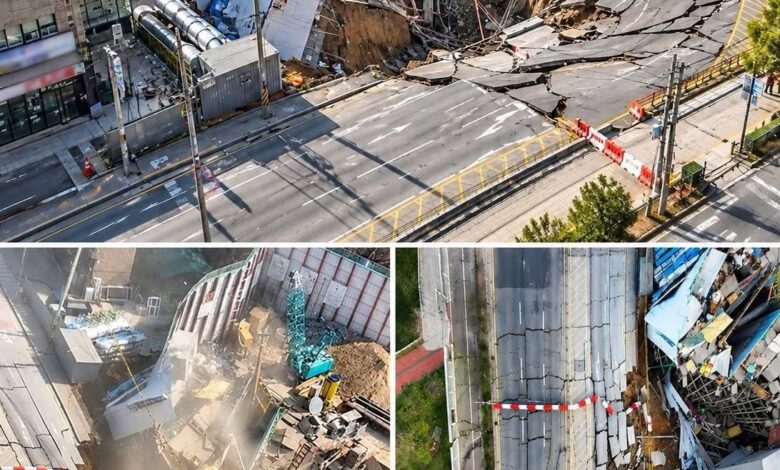
Heavy machinery can remove large amounts of material, but it cannot always operate safely in a confined underground space. In some situations, rescue specialists must rely on smaller equipment and carefully controlled manual work.
The physical conditions can also be exhausting. Underground rescue teams may face poor ventilation, dust, darkness, restricted movement, and long periods of intense concentration.
The trapped workers face their own dangers. Injuries, dehydration, cold temperatures, stress, and limited mobility can all complicate survival.
The excavator operator in Gwangmyeong was eventually rescued after approximately 13 hours underground. Reports said he had been trapped around 30 meters below the surface. He was conscious when reached and was taken to hospital for treatment.
His rescue was an important breakthrough, but the operation was not over. Another worker remained missing, and authorities continued searching through the damaged underground structure.
For the rescue teams, finding one survivor did not lessen the responsibility to keep looking for the other.
Chapter 3: One Worker Survived, Another Was Still Missing
The rescue of the excavator operator offered a moment of hope during an extremely difficult operation.
The worker, a man in his twenties, had reportedly been repairing an excavator when he went to get some water. During that brief moment, the ground collapsed and he fell into the underground debris.
He was trapped approximately 30 meters below the surface. Parts of his lower body were pinned beneath concrete slabs and other debris, restricting his movement.
Despite the conditions, he managed to contact rescuers using his mobile phone. That communication helped establish that he was alive and gave emergency personnel a vital starting point for the rescue.
The rescue operation required patience and precision. Firefighters and specialists worked to reach him while attempting to avoid disturbing the unstable material around his body.
According to reports published after the incident, rescuers were eventually able to make face-to-face contact with him. He showed signs of dehydration, and personnel provided him with drinks and food while preparing to remove him.
After approximately 13 hours underground, he was brought to the surface using a crane.
He was transported to a trauma center for treatment. Reports said he had suffered a fractured collarbone and dehydration, although his condition was not considered life-threatening at the time.
koreajoongangdaily
The rescue was a remarkable achievement for the emergency teams. But the relief was incomplete.
A second worker, a man in his fifties, remained missing.
Authorities believed he had been inside or near a temporary container at the time of the collapse. Determining his exact location was difficult because the structure and surrounding debris had been heavily damaged.
The search continued for several days.
Rescue workers used heavy machinery, specialized equipment, and search dogs to investigate the underground area. They also removed large quantities of soil and sand while creating a route toward the lower section of the collapsed structure.
The operation was complicated by the risk of further ground movement. Officials had to consider the possibility that removing one section of debris could destabilize another.
On April 16, six days after the collapse, rescuers found the missing worker. He was pronounced dead, bringing the search to a tragic conclusion.
The outcome highlighted the human cost of underground construction accidents.
Behind every rescue operation are workers with families, responsibilities, and lives outside the construction site. A worker who enters a tunnel for a shift may be someone else’s parent, partner, child, or friend.
For the families waiting outside, the uncertainty can be devastating. News that one person has survived may bring hope, while the continued absence of another can prolong an agonizing period of waiting.
The incident ended with one worker surviving and another losing his life. It was a reminder that even when rescue teams work tirelessly, the conditions created by a structural collapse can make a successful outcome impossible for everyone involved.
Chapter 4: Why Can Underground Construction Sites Collapse?
Underground construction is among the most technically demanding forms of civil engineering.
Before a tunnel is built, engineers must understand the geology beneath the surface. Soil type, groundwater levels, nearby foundations, buried utilities, and existing underground structures can all influence how excavation should proceed.
A tunnel that appears stable during one stage of construction may become vulnerable as more material is removed or as pressure changes around the excavation.
One important risk is the movement of soil.
When workers excavate underground, the surrounding ground loses some of the support that previously held it in place. Temporary support systems are therefore installed to help maintain stability until permanent structural elements are completed.
These systems may include steel supports, concrete linings, retaining walls, ground anchors, and other reinforcement methods.
If a support structure becomes damaged, overloaded, or unable to resist the surrounding pressure, cracks and deformation may develop.
Water is another major concern.
Groundwater can enter an excavation through cracks or weak areas. If water begins carrying soil particles with it, the surrounding ground may gradually lose strength.
A damaged water pipe can make the situation worse by allowing large quantities of water to enter the construction area. In certain conditions, this can contribute to ground settlement or a sudden collapse.
Other possible contributing factors include:
Unexpected geological conditions.
Inadequate or damaged temporary supports.
Errors in excavation sequencing.
Changes in groundwater pressure.
Vibrations from machinery or nearby construction.
Insufficient monitoring of structural movement.
Damage to underground utility lines.
These are general engineering risks, not confirmed explanations for the Gwangmyeong accident.
In that incident, authorities had reported cracks in several tunnel support pillars before the collapse. The exact causes and possible responsibility required investigation rather than assumption.
Warning signs can include cracks in concrete, unusual sounds, water seepage, unexpected ground settlement, and changes in the position of support structures.
Such signs must be assessed by qualified engineers. Workers should not be expected to decide independently whether a damaged structure is safe.
A strong safety system depends on clear reporting procedures, regular inspections, accurate monitoring, and the authority to stop work when conditions become dangerous.
It is also essential that contractors, subcontractors, engineers, and project supervisors understand their responsibilities.
Construction schedules and financial pressures must never override immediate safety concerns. If a structural problem is identified, work should not continue simply because a project is behind schedule.
The Gwangmyeong collapse demonstrated why early warning systems matter. A crack in a support pillar may appear to be a localized defect, but in an underground structure it can indicate a much larger problem.
Monitoring equipment, engineering inspections, and effective communication between workers and supervisors can help identify risks before they develop into emergencies.
No monitoring system can eliminate every possibility of failure. However, a strong safety culture can reduce the likelihood that warning signs will be ignored.
Chapter 5: The Investigation and the Lessons for Future Projects
After a major construction collapse, rescuing victims is only the first stage of the response.
Once the site has been secured, authorities must determine what happened, why it happened, and whether required safety procedures were followed.
The investigation may involve examining construction documents, inspection records, engineering calculations, maintenance reports, site communications, and physical evidence recovered from the damaged area.
Investigators may also interview workers, supervisors, engineers, and representatives of the companies involved.
In the Gwangmyeong case, the consequences extended beyond the immediate rescue operation.
On April 25, 2025, police and labor authorities raided POSCO E&C and subcontractors as part of an investigation into the collapse. Yonhap reported that investigators were examining possible occupational negligence and whether safety regulations had been followed. Three officials had been booked in connection with the case at that stage.
The investigation was important because a major structural failure rarely has just one simple explanation.
A collapse may involve several interacting factors: design decisions, construction methods, material conditions, inspection procedures, groundwater behavior, and the way workers respond to warning signs.
Determining responsibility requires evidence. It would be inappropriate to declare a particular person or company responsible before the investigation and legal process establish the facts.
The incident also carries lessons for future infrastructure projects.
First, warning signs must lead to action.
Cracks, unusual movement, water leakage, and unexpected sounds should be documented and assessed immediately. If a structure may be unsafe, workers should be evacuated and the site secured until qualified personnel determine what is happening.
Second, emergency plans must be practical.
A rescue plan should identify access routes, emergency exits, communication systems, ventilation arrangements, and procedures for dealing with hazardous gases or water intrusion.
Regular exercises can help emergency personnel and construction workers understand their roles before an actual accident occurs.
Third, workers need the authority to report danger.
People working closest to an excavation may be the first to notice unusual changes. They must be able to report concerns without fear of punishment or pressure to continue working.
Fourth, safety inspections must be meaningful.
An inspection should not become a routine exercise in completing paperwork. It must identify actual hazards, assess their seriousness, and ensure that corrective action is taken.
Finally, responsibility should continue throughout the life of a project. A tunnel is not safe simply because its initial design was approved. Ground conditions can change, temporary supports can deteriorate, and unexpected problems can emerge as construction progresses.
The collapse in Gwangmyeong was a tragedy that cost one worker his life and left another injured. It also placed a spotlight on the difficult work performed by underground construction crews and the emergency personnel who respond when something goes wrong.
Subway systems are essential to modern cities. They reduce travel times, connect communities, and support economic development. But the benefits of new infrastructure cannot come at the expense of the people who build it.
Every tunnel, station, and underground passage depends on workers who trust that the structures around them have been properly designed, inspected, and maintained.
That trust must be supported by strong engineering, transparent oversight, and a willingness to stop work whenever safety is in doubt.