I Called My Husband Thirty Times While His Mother Was Dying and She Left Me a Silver Key
“Will you stop calling me like a crazy person, Rosalyn? I’m buried in critical negotiations.”
My husband’s voice came through the phone sharp and impatient. The same tone he always used when he wanted me to feel guilty for interrupting him.
For one second, I almost admired how smoothly he said it.
Because behind his rehearsed frustration, I could hear waves rolling up onto a beach. A young woman laughing, close to the phone. And the bright, clear clink of champagne glasses.
Christopher had told me he was flying out for a last-minute business negotiation that could “change everything” for us.
He’d packed two linen shirts I’d never once seen him wear to a meeting. He’d taken the expensive Ray-Bans he only wore on vacation. He’d kissed my forehead at the door without looking me in the eyes.
I’d noticed all of it.
I’d just been too exhausted to say anything.
Now he wanted me to believe he was trapped in a conference room. While the ocean rolled in behind him.
I didn’t accuse him.
I didn’t ask who the woman was.
I stood in the middle of our living room with one hand wrapped around my phone, and I looked at the white urn sitting on the mantel above our fireplace.
Christopher had no idea his mother was dead.
He had no idea I’d signed the cremation papers. Chosen the service time. Called her friends. Folded the navy dress she’d once asked to be buried in.
He had no idea I’d sat alone at our kitchen table with a cold paper cup of hospital coffee, answering questions that should have belonged to her son.
“Are you even listening to me?” he snapped.
“Yes,” I said.
The woman near him laughed again. Lower this time. Like somebody had leaned in close and whispered in her ear.
Christopher covered the phone. But not fast enough.
When he came back, his voice had changed. It was softer now. Almost patient. The voice he used when he wanted to make cruelty sound reasonable.
“Ros. I can’t keep dropping everything every time you panic,” he said. “Mom’s had bad nights before.”
I looked at the urn.
And I felt something inside me settle.
Not break. Not explode.
Settle.
My name is Rosalyn Whitaker. I’m forty-nine years old. I’ve been married to Christopher Whitaker for twenty years.
And for twenty years, I’d mistaken endurance for loyalty.
I need to tell you about the night before.
The emergency room at Cooper University Hospital in Camden, New Jersey, was washed in that harsh fluorescent light that makes every face look exhausted.
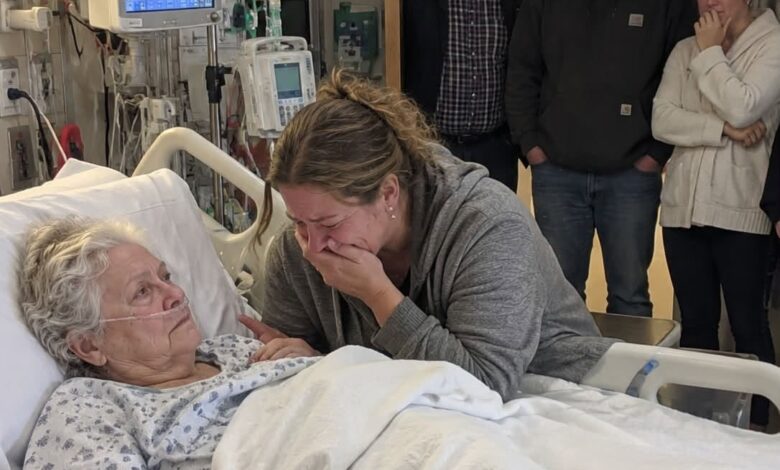
Gertrude lay under a thin hospital blanket with an oxygen mask over her nose and mouth. The mask fogged faintly with every shallow breath.
Her hand rested in mine. Cold at the fingertips. Papery across the knuckles.
The heart monitor beside her bed kept changing its rhythm. Speeding up. Slowing down. Speeding up again. I was afraid to look away from it.
“Gertrude,” I whispered. “Please don’t leave me.”
A nurse adjusted a line. Checked the screen. Told me someone would be in to speak with me soon.
I nodded like I understood what that meant.
Then I called Christopher again.
The first few calls had been practical. Calm.
“Your mom’s in the ER. Please call me.”
“The doctors are worried, Chris. Call me back.”
By the tenth call, I’d stopped pretending to be calm.
By the twentieth, I was leaving messages I could barely understand when I played them back later.
“Christopher, pick up.”
“Please. This is serious. This is really serious.”
“She keeps asking for you.”
That last one wasn’t completely true. Gertrude had stopped talking before the ambulance even got to the hospital.
But I wanted him to picture his mother still waiting for him. I wanted something, anything, to break through his silence.
Twenty-eight calls.
Twenty-nine.
Thirty.
Every single one went straight to voicemail.
I lowered the phone and watched the screen go dark in my hand.
“I’m so sorry, Mom,” I told her. “I can’t reach him.”
I’d called her Mom for years.
Nobody ever asked me to. The word just came slowly. Through ordinary things.
It started the first winter after Christopher and I got married. I was working late shifts as a pharmacy tech at a Rite Aid. Gertrude showed up at our little apartment in Cherry Hill with a slow cooker, two bags of groceries, and a handwritten recipe for beef stew. Because she’d heard I wasn’t eating right.
It got deeper the year Christopher forgot my birthday. Gertrude remembered. She drove across town after dark with a grocery-store sheet cake sliding around on the passenger seat of her Buick.
It became permanent after my miscarriage.
Sophia Rivers is an experienced News Content Editor with a sharp eye for detail and a passion for delivering accurate and engaging news stories. At TheArchivists , she specializes in curating, editing, and presenting news content that informs and resonates with a global audience.
Sophia holds a degree in Journalism from the University of Toronto, where she developed her skills in news reporting, media ethics, and digital journalism. Her expertise lies in identifying key stories, crafting compelling narratives, and ensuring journalistic integrity in every piece she edits.
Known for her precision and dedication to the truth, Sophia thrives in the fast-paced world of news editing. At TheArchivists , she focuses on producing high-quality news content that keeps readers informed while maintaining a balanced and insightful perspective.
With a commitment to delivering impactful journalism, Sophia is passionate about bringing clarity to complex issues and amplifying voices that matter. Her work reflects her belief in the power of news to shape conversations and inspire change.
I was thirty-one.
We’d tried for three years. When I finally got pregnant, Christopher bought a little stuffed giraffe and set it on the dresser. I thought that meant he was all in.
At fourteen weeks, I started bleeding at work.
Christopher spent most of that afternoon in the hospital hallway answering work emails on his BlackBerry. Telling people he’d call them back.
Gertrude sat beside my bed.
She didn’t tell me everything happens for a reason. She didn’t tell me to be strong. She didn’t tell me I’d have another one.
She held a paper cup of water to my lips when my hands were shaking too badly to hold it. She tucked the blanket around my cold feet. And she stayed with me until I fell asleep.
When I woke up at two in the morning, she was still there. Asleep in the plastic chair. Her purse in her lap. Her coat still on.
Christopher had gone home to sleep.
We never got pregnant again.
Years later, when arthritis twisted Gertrude’s fingers so badly she couldn’t do small buttons anymore, I started stopping by her little cottage every Sunday before church to button her coat.
When she couldn’t drive at night anymore, I took her to her appointments.
When her memory started slipping two years ago, Christopher and I moved her into our guest room. I labeled every drawer. I set alarms on my phone for all eleven of her medications.
Christopher thanked me the way you’d thank somebody for picking up a gallon of milk.
“You’re a lifesaver, Ros.”
He always promised he’d spend more time with her. Next week. After this deal. After this trip.
There was always a flight. A deadline. A client dinner. A call he couldn’t move.
And Gertrude defended him longer than I did.
“He works so hard, honey.”
“He has people depending on him.”
“He’ll slow down when this deal is over.”
The deal was never over.
There was always another one right behind it.
Sophia Rivers is an experienced News Content Editor with a sharp eye for detail and a passion for delivering accurate and engaging news stories. At TheArchivists , she specializes in curating, editing, and presenting news content that informs and resonates with a global audience.
Sophia holds a degree in Journalism from the University of Toronto, where she developed her skills in news reporting, media ethics, and digital journalism. Her expertise lies in identifying key stories, crafting compelling narratives, and ensuring journalistic integrity in every piece she edits.
Known for her precision and dedication to the truth, Sophia thrives in the fast-paced world of news editing. At TheArchivists , she focuses on producing high-quality news content that keeps readers informed while maintaining a balanced and insightful perspective.
With a commitment to delivering impactful journalism, Sophia is passionate about bringing clarity to complex issues and amplifying voices that matter. Her work reflects her belief in the power of news to shape conversations and inspire change.
That night in the ER, I put my forehead down on the edge of Gertrude’s mattress and I cried until my chest hurt.
I cried for her.
I cried for the son who wasn’t coming.
I cried for the woman I’d turned into, spending twenty years trying to make his absence look respectable.
Then Gertrude’s fingers moved.
At first I thought it was a reflex.
Then her hand tightened around mine. With a sudden strength that made me sit straight up.
Her eyes opened.
They were tired. But they were clear.
She looked right at my face. Like she’d been waiting for one last moment when I’d finally stop looking at the door.
Behind the oxygen mask, her lips moved.
No sound came out.
But after twenty years, I understood her anyway.
No more crying.
It’s time.
Her other hand moved under the blanket. Slowly. Painfully.
She reached inside the collar of her hospital gown. And she pulled something out.
The effort made her breathing change. The monitor beeped faster.
I leaned in, scared she was pulling out one of her IV lines. But she caught my wrist with her bony fingers. And she pressed something into my palm.
It was cold. Metal. Small. Uneven along one edge.
I closed my fingers around it before I even saw what it was.
Gertrude’s grip loosened.
The monitor changed.
One tone stretched into another. And then the whole room filled with a single, long, unbroken sound.
A nurse rushed in. Then another one. Then a doctor.
Someone gently guided me away from the bed. Calm voices gave instructions I couldn’t follow.
I stood against the wall with both hands clenched against my stomach.
One fist held my phone.
The other fist held the very last thing Gertrude Whitaker had chosen to give anybody in this world.
At 11:47 p.m., the room went quiet.
A young nurse with a ponytail came over and touched my arm.
“I’m so sorry. Is there anyone I can call for you?”
I looked down at my phone. At Christopher’s name on the screen.
Thirty calls from me.
Nothing from him.
“No,” I said. “There isn’t.”
Sophia Rivers is an experienced News Content Editor with a sharp eye for detail and a passion for delivering accurate and engaging news stories. At TheArchivists , she specializes in curating, editing, and presenting news content that informs and resonates with a global audience.
Sophia holds a degree in Journalism from the University of Toronto, where she developed her skills in news reporting, media ethics, and digital journalism. Her expertise lies in identifying key stories, crafting compelling narratives, and ensuring journalistic integrity in every piece she edits.
Known for her precision and dedication to the truth, Sophia thrives in the fast-paced world of news editing. At TheArchivists , she focuses on producing high-quality news content that keeps readers informed while maintaining a balanced and insightful perspective.
With a commitment to delivering impactful journalism, Sophia is passionate about bringing clarity to complex issues and amplifying voices that matter. Her work reflects her belief in the power of news to shape conversations and inspire change.
I signed the first forms before midnight.
Questions about burial or cremation. Personal belongings. Who had legal authority to make decisions.
Every question felt like a door Christopher should have walked through.
He never did.
I gave them everything I knew. Twenty years of filling out Gertrude’s paperwork.
Her birthday. March 3rd, 1944. Her medication list. All eleven. Her preferred funeral home, Bradley and Sons on Haddon Avenue. The church she stopped going to when the front steps got too hard for her knees. The phone number of her friend Dottie, who still mailed her a Christmas card every single year.
By morning, I’d done everything grief required.
I drove home through empty streets with Gertrude’s overnight bag on the passenger seat.
Her reading glasses were tucked into the side pocket. A half-finished roll of Brach’s peppermints sat at the bottom, next to a folded tissue and a little bottle of Jergens hand lotion.
At a red light on Route 70, I put my hand on that bag. Like steadying it could steady me.
Christopher sent a text just after sunrise.
In meetings all day. Don’t create a crisis while I’m gone.
I read it once.
Then I turned my phone face down on the seat.
The funeral arrangements took the whole next day.
I chose the plain white urn. The funeral director had offered three. A dark wood box. A blue ceramic one with painted roses. And a plain white one. Gertrude always hated anything she called “fussy.”
I approved a short notice for the Courier-Post. I found her navy dress in the guest room closet and held it against my chest for a long time before I folded it back into the garment bag.
I called the people she would’ve wanted called.
At first, nobody asked where Christopher was. They all assumed he was on his way.
I let them assume it. I didn’t have the strength to explain him.
When Mr. Bradley at the funeral home asked if we should wait to schedule the memorial until her son got back, I looked at the calendar on his wall. And I thought about thirty calls disappearing into voicemail.
“No,” I said. “She’s waited long enough.”
That evening, I set the urn on the mantel above our fireplace.
The house looked exactly the same as it did before.
Christopher’s loafers by the back door. His unopened mail stacked neatly on the kitchen counter. A dry-cleaning ticket stuck to the refrigerator with a magnet shaped like a lobster from Cape May.
The ordinary shape of our life made the loss feel almost impossible.
Then I finally opened my hand.
Sophia Rivers is an experienced News Content Editor with a sharp eye for detail and a passion for delivering accurate and engaging news stories. At TheArchivists , she specializes in curating, editing, and presenting news content that informs and resonates with a global audience.
Sophia holds a degree in Journalism from the University of Toronto, where she developed her skills in news reporting, media ethics, and digital journalism. Her expertise lies in identifying key stories, crafting compelling narratives, and ensuring journalistic integrity in every piece she edits.
Known for her precision and dedication to the truth, Sophia thrives in the fast-paced world of news editing. At TheArchivists , she focuses on producing high-quality news content that keeps readers informed while maintaining a balanced and insightful perspective.
With a commitment to delivering impactful journalism, Sophia is passionate about bringing clarity to complex issues and amplifying voices that matter. Her work reflects her belief in the power of news to shape conversations and inspire change.
A tiny silver key lay in my palm.
There was no tag on it. No number. No note.
The edges were worn smooth in places. Like Gertrude had held it a lot. Run her thumb over it.
I searched her overnight bag. Her coat pockets. The little zippered pouch where she kept her Medicare card and her pharmacy receipts.
Nothing.
I went through the guest room dresser. The jewelry box she’d brought from her cottage. The shoebox of photographs on her closet shelf.
Nothing explained the key.
I stood in the middle of that guest room and remembered the look in her eyes.
Gertrude had hidden that key inside her clothing during the last hours of her life. She’d kept it close while nurses moved her and changed her gown. And she’d used the very last of her strength to put it in my hand.
Not Christopher’s.
Mine.
By the time Christopher finally called that next evening, I’d already printed out the divorce papers.
I’d had them saved on my laptop for almost a year. Ever since I found a hotel receipt from Atlantic City in his gym bag on a weekend he swore he was in Pittsburgh.
I’d never been brave enough to print them.
That night, I printed them. I filled in every section I could. I laid them on the dining room table, next to an envelope with all the information about his mother’s memorial service.
And I set my wedding ring on top of the first page.
The pale mark it left around my finger looked more honest than the ring ever had.
And then I answered his call. Because some part of me wanted to hear whether he’d tell me the truth on his own.
He didn’t.
He gave me critical negotiations. He gave me irritation. He gave me the ocean and another woman’s laughter.
He told me his mother had had bad nights before.
I listened until he ran out of patience.
Then I said, “Enjoy your trip, Christopher.”
“It’s not a trip.”
“Of course not.”
“What’s that supposed to mean?”
I looked at the urn. At the divorce papers. At the little silver key sitting next to my bare left hand on the table.
“It means I won’t call you again,” I said.
He let out a hard breath.
“Good.”
That one word ended twenty years more cleanly than any fight ever could have.
I hung up.
Sophia Rivers is an experienced News Content Editor with a sharp eye for detail and a passion for delivering accurate and engaging news stories. At TheArchivists , she specializes in curating, editing, and presenting news content that informs and resonates with a global audience.
Sophia holds a degree in Journalism from the University of Toronto, where she developed her skills in news reporting, media ethics, and digital journalism. Her expertise lies in identifying key stories, crafting compelling narratives, and ensuring journalistic integrity in every piece she edits.
Known for her precision and dedication to the truth, Sophia thrives in the fast-paced world of news editing. At TheArchivists , she focuses on producing high-quality news content that keeps readers informed while maintaining a balanced and insightful perspective.
With a commitment to delivering impactful journalism, Sophia is passionate about bringing clarity to complex issues and amplifying voices that matter. Her work reflects her belief in the power of news to shape conversations and inspire change.
I packed one suitcase.
My ID. A few changes of clothes. Gertrude’s overnight bag. And the shoebox of photographs she’d trusted me to sort out for her.
I left Christopher’s mail where it was. I left his loafers by the door.
And I left the white urn on the mantel. Because right then, it was the only place he’d be forced to see what he’d refused to face.
I put the little silver key in the inside pocket of my coat.
Outside, the morning was bright and ordinary. A minivan rolled past the end of our driveway. Across the street, Mr. Petrakis was dragging his trash can to the curb.
The world hadn’t changed at all. Even though mine had ended.
I locked the front door. I slid my house key through the mail slot.
And I drove away without telling Christopher where I was going.
I went to the only place I could think of.
Gertrude’s cottage.
It’s a little white Cape Cod with green shutters in Haddonfield. Ten minutes from our house. She lived there for forty-one years with her husband, Walter, until he died, and then alone until she couldn’t anymore.
When she moved in with us, Christopher wanted to sell it right away.
“It’s just sitting there, Mom. We could get four hundred thousand for it. You don’t need it.”
Gertrude said no.
It was the only time I ever heard her tell her son no.
The house had been empty for two years. I still had a key. I’d been going over once a week to water her African violets and run the faucets so the pipes wouldn’t freeze.
I let myself in.
It smelled exactly like her. Lemon Pledge and peppermint and old books.
I sat down in Walter’s old recliner by the window. And for the first time since the hospital, I let myself feel all of it.
Then I took the little silver key out of my coat pocket.
And I started looking.
I tried every lock in that house.
The front door. The back door. The cedar chest at the foot of her bed. Walter’s old roll-top desk. The china cabinet. The little jewelry box on her dresser. The padlock on the shed out back.
Nothing fit.
It was too small. Smaller than a house key. Smaller than a padlock key.
I sat back down in the recliner at two in the morning, holding that key up to the lamp.
That’s when I finally noticed it.
Stamped into the metal, so faint I’d missed it a dozen times, worn almost smooth from Gertrude’s thumb.
Three tiny numbers.
214.
And under that, even smaller. Two letters.
H.N.B.
Haddonfield National Bank.
It was a safe deposit box key.
Sophia Rivers is an experienced News Content Editor with a sharp eye for detail and a passion for delivering accurate and engaging news stories. At TheArchivists , she specializes in curating, editing, and presenting news content that informs and resonates with a global audience.
Sophia holds a degree in Journalism from the University of Toronto, where she developed her skills in news reporting, media ethics, and digital journalism. Her expertise lies in identifying key stories, crafting compelling narratives, and ensuring journalistic integrity in every piece she edits.
Known for her precision and dedication to the truth, Sophia thrives in the fast-paced world of news editing. At TheArchivists , she focuses on producing high-quality news content that keeps readers informed while maintaining a balanced and insightful perspective.
With a commitment to delivering impactful journalism, Sophia is passionate about bringing clarity to complex issues and amplifying voices that matter. Her work reflects her belief in the power of news to shape conversations and inspire change.
Haddonfield National Bank opens at nine.
I was sitting in my car in the parking lot at 8:40.
The bank is small. Old brick. A Main Street bank that’s been there since 1952. A teller named Doris has worked there since I first started bringing Gertrude in to cash her Social Security checks twelve years ago.
Doris saw me walk in and her face fell.
“Oh, Rosalyn. I saw the notice in the paper. I’m so sorry, honey.”
“Thank you, Doris.”
I held up the key.
“I think this belongs to Gertrude’s safe deposit box. I didn’t even know she had one.”
Doris looked at the key. Then she looked at me with an expression I didn’t understand.
“She came in eight months ago,” Doris said quietly. “With her lawyer. She added you to the box. As a joint renter. She said you’d come someday.”
My knees almost gave out.
Doris took me back to the vault herself. She used the bank’s key. I used mine.
The little metal door swung open.
Doris slid out a long, narrow steel box and set it on a table in a tiny private room. Then she left me alone and closed the door.
I sat there for a long time before I opened it.
Inside were three things.
A thick manila envelope with “Last Will and Testament of Gertrude A. Whitaker” typed on the front. Dated eight months earlier.
A second envelope. Thinner. Stuffed with bank statements, photocopied checks, and receipts.
And a pink envelope with my name on the front.
In Gertrude’s handwriting. Shaky. The letters crooked from arthritis.
Rosalyn.
I opened that one first.
My dearest Rosalyn,
If you’re reading this, then I’m gone. And if I know my son, he wasn’t there. And you were.
I’m sorry I left you to do it alone. I’m sorry I left you to do so much alone for so long.
I want you to know that I saw everything. I’m old, honey. I’m not blind.
I saw who buttoned my coat. I saw who sat with me at every appointment. I saw who labeled my drawers so I wouldn’t feel stupid when I forgot where my socks were.
And I saw who didn’t.
Sophia Rivers is an experienced News Content Editor with a sharp eye for detail and a passion for delivering accurate and engaging news stories. At TheArchivists , she specializes in curating, editing, and presenting news content that informs and resonates with a global audience.
Sophia holds a degree in Journalism from the University of Toronto, where she developed her skills in news reporting, media ethics, and digital journalism. Her expertise lies in identifying key stories, crafting compelling narratives, and ensuring journalistic integrity in every piece she edits.
Known for her precision and dedication to the truth, Sophia thrives in the fast-paced world of news editing. At TheArchivists , she focuses on producing high-quality news content that keeps readers informed while maintaining a balanced and insightful perspective.
With a commitment to delivering impactful journalism, Sophia is passionate about bringing clarity to complex issues and amplifying voices that matter. Her work reflects her belief in the power of news to shape conversations and inspire change.
I had to stop reading. I couldn’t see the paper.
After a while, I kept going.
Last spring, I asked Christopher to bring me my checkbook. He said he’d been handling the bills for me. That I didn’t need to worry about it.
I worried about it anyway. You know how I am.
So I asked Doris at the bank to print out my statements. And I asked my old friend Harold Abernathy, the lawyer who did Walter’s will, to look at them with me.
Rosalyn, my son has been taking money out of my accounts for two years.
He used the power of attorney I signed when my memory started going. Eighty-six thousand dollars. Everything is in the second envelope. Hotels in Atlantic City. A jewelry store in Philadelphia. Airline tickets to the Turks and Caicos. Two of them. For him and a woman named Brielle.
I don’t want you to feel sorry for me. I felt sorry enough for both of us.
I didn’t confront him. I’m too old and too tired, and I knew he would only lie, and then he’d watch me closer.
So I did what Walter would have done. I went to Harold. And I fixed it quietly.
I revoked Christopher’s power of attorney. Harold filed the papers with the bank. Christopher doesn’t know yet. He’ll find out when he tries to use it.
And I changed my will.
Rosalyn, you’re going to want to argue with me. Don’t. I’ve made up my mind. My mind isn’t what it used to be, but it’s still mine, and Harold has three doctors’ letters saying so.
My cottage is yours. My savings are yours. What’s left of them, anyway.
Christopher gets Walter’s watch and his tackle box. And a letter from me. Harold has it. It’s not a kind letter. He’s earned it.
And the eighty-six thousand dollars he took? Harold says the estate has every right to ask for it back. I’m leaving that decision to you, honey. You’ll know what to do. You always do.
You called me Mom for twenty years. You never had to. And I never told you how much it meant.
So I’m telling you now.
You were the daughter I always wanted. You were the best thing my son ever brought home. He just never knew it.
No more crying, honey. It’s time.
Go live your life.
All my love, Mom.
P.S. Water my violets. They like the kitchen window.
Sophia Rivers is an experienced News Content Editor with a sharp eye for detail and a passion for delivering accurate and engaging news stories. At TheArchivists , she specializes in curating, editing, and presenting news content that informs and resonates with a global audience.
Sophia holds a degree in Journalism from the University of Toronto, where she developed her skills in news reporting, media ethics, and digital journalism. Her expertise lies in identifying key stories, crafting compelling narratives, and ensuring journalistic integrity in every piece she edits.
Known for her precision and dedication to the truth, Sophia thrives in the fast-paced world of news editing. At TheArchivists , she focuses on producing high-quality news content that keeps readers informed while maintaining a balanced and insightful perspective.
With a commitment to delivering impactful journalism, Sophia is passionate about bringing clarity to complex issues and amplifying voices that matter. Her work reflects her belief in the power of news to shape conversations and inspire change.
I sat in that little room at Haddonfield National Bank for almost an hour.
Doris finally knocked on the door and brought me a cup of water and a box of Kleenex.
“Is everything all right, honey?”
I looked up at her.
“She knew,” I said. “She knew everything.”
Doris sat down across from me.
“She sat right there in that chair eight months ago,” Doris said, “and she told me, ‘Doris, when Rosalyn comes in with that key, you be gentle with her. She’s going to have been through it.'”
I called Harold Abernathy from the parking lot.
He’s eighty-two. He still goes into his office on Kings Highway three days a week. He answered on the first ring.
“Mrs. Whitaker,” he said. “I’ve been waiting for your call. I’m so sorry about Gertrude.”
“Mr. Abernathy,” I said. “I just read her letter.”
“Then you know.” He paused. “She was the sharpest client I’ve had in fifty years. Even at the end. Especially at the end.”
He told me everything.
The revocation of the power of attorney was filed with the bank eight months ago. Christopher hadn’t touched Gertrude’s accounts since then. He probably thought it was a technical glitch.
Gertrude’s will was airtight. Signed in Harold’s office. Witnessed by two of his staff. With letters from her primary care doctor, her neurologist, and a psychiatrist all confirming she had full capacity to make her decisions.
“She insisted on the psychiatrist,” Harold said. “She said, ‘Christopher’s going to say I was confused. Let’s take that off the table.'”
The documentation of the money Christopher took was all there. Every withdrawal. Every check he wrote to himself. Every credit card payment.
“Mrs. Whitaker,” Harold said gently. “There’s something else. When Gertrude came to me, she asked me to look into whether what Christopher did was a crime.”
“Was it?”
“Using a power of attorney for your own benefit, without the person’s permission, is financial exploitation of an elderly person,” Harold said. “In New Jersey, that’s a crime. Gertrude decided not to report it while she was alive. She didn’t want her son arrested while she was still breathing.”
He paused.
“She left the decision to you.”
I sat in my car in the bank parking lot, holding that pink envelope against my chest.
“I need a few days,” I said.
“Take all the time you need,” Harold said. “He can’t touch anything now.”
Sophia Rivers is an experienced News Content Editor with a sharp eye for detail and a passion for delivering accurate and engaging news stories. At TheArchivists , she specializes in curating, editing, and presenting news content that informs and resonates with a global audience.
Sophia holds a degree in Journalism from the University of Toronto, where she developed her skills in news reporting, media ethics, and digital journalism. Her expertise lies in identifying key stories, crafting compelling narratives, and ensuring journalistic integrity in every piece she edits.
Known for her precision and dedication to the truth, Sophia thrives in the fast-paced world of news editing. At TheArchivists , she focuses on producing high-quality news content that keeps readers informed while maintaining a balanced and insightful perspective.
With a commitment to delivering impactful journalism, Sophia is passionate about bringing clarity to complex issues and amplifying voices that matter. Her work reflects her belief in the power of news to shape conversations and inspire change.
Christopher came home three days later.
I wasn’t there. But Mr. Petrakis from across the street told me about it afterward. He was out raking leaves.
Christopher’s Uber pulled up at around six in the evening. He climbed out with a tan he didn’t have when he left, carrying his rolling suitcase and a bag from the duty-free shop.
He walked up to the front door. He tried his key.
It worked. I hadn’t changed the locks. It was his house too.
He walked inside.
Mr. Petrakis said it was quiet for about five minutes.
Then he heard Christopher yell. One word.
“MOM?”
He’d seen the urn.
And next to it, on the dining room table, the divorce papers. And my wedding ring. And the envelope with the date of his mother’s memorial service.
The memorial service had been that morning.
At St. Mary’s. Ten a.m. Sixty-one people came. Dottie flew up from Florida. Doris from the bank came. The Haddonfield Garden Club came in a group, all wearing the green corsages they wear to everything.
I gave the eulogy.
Christopher’s chair, in the front row, was empty.
That night, my phone rang forty-one times.
I didn’t answer any of them.
Then, at eleven o’clock, he texted.
Where are you? Why didn’t you tell me? How could you not tell me my own mother died?
I looked at that text for a long time.
Then I took a screenshot of my call log from the night Gertrude died.
Thirty outgoing calls. All to Christopher. From 7:52 p.m. to 11:41 p.m.
I sent it to him without a word.
He didn’t text again that night.
The next morning, Harold Abernathy called Christopher and asked him to come to his office on Kings Highway that Friday. For the reading of his mother’s will.
Sophia Rivers is an experienced News Content Editor with a sharp eye for detail and a passion for delivering accurate and engaging news stories. At TheArchivists , she specializes in curating, editing, and presenting news content that informs and resonates with a global audience.
Sophia holds a degree in Journalism from the University of Toronto, where she developed her skills in news reporting, media ethics, and digital journalism. Her expertise lies in identifying key stories, crafting compelling narratives, and ensuring journalistic integrity in every piece she edits.
Known for her precision and dedication to the truth, Sophia thrives in the fast-paced world of news editing. At TheArchivists , she focuses on producing high-quality news content that keeps readers informed while maintaining a balanced and insightful perspective.
With a commitment to delivering impactful journalism, Sophia is passionate about bringing clarity to complex issues and amplifying voices that matter. Her work reflects her belief in the power of news to shape conversations and inspire change.
I almost didn’t go.
Harold told me I didn’t have to. But I wanted to look Christopher in the eye one time.
I wore the navy dress. Not Gertrude’s. Mine. I bought it at Macy’s the day after the memorial because it was the same color as hers.
I got there first. Harold’s office smells like old leather and pipe tobacco, even though he quit smoking in 1991.
Christopher walked in at ten after two. He was still tan. He looked like he hadn’t slept in three days.
He stopped when he saw me.
“Ros,” he said.
I didn’t say anything.
He sat down in the chair across from me. Harold’s big oak desk between us.
“I should have been there,” Christopher said. “I know that.”
“Yes,” I said. “You should have.”
“I didn’t know it was that bad.”
“I called you thirty times, Christopher.”
He looked at the floor.
“I thought you were overreacting,” he said quietly.
“You were in the Turks and Caicos,” I said. “With Brielle.”
His head snapped up. His face went white under the tan.
“How do you know her name?”
“Your mother told me,” I said.
Harold cleared his throat. He opened a blue folder.
And he read Gertrude’s will out loud. Every word.
When he got to the part about the cottage and the savings going to me, Christopher stood up.
“That’s insane. She was confused. She had dementia. That will isn’t valid.”
Harold didn’t even look up. He slid three letters across the desk.
“Her primary care physician. Her neurologist. And a board-certified psychiatrist,” Harold said. “All three examined her in the week before she signed this will. All three confirm full testamentary capacity. Your mother insisted on it. She said, and I quote, ‘Christopher’s going to say I was confused.'”
Christopher stared at the letters.
Then Harold slid the second envelope across the desk. The thick one. With the bank statements and the receipts.
“And your mother asked me to give you this,” Harold said. “It’s a complete accounting of eighty-six thousand, four hundred and twelve dollars that left her accounts under your power of attorney between March of 2023 and February of this year.”
Christopher didn’t touch the envelope.
He didn’t have to. He knew exactly what was in it.
He sat back down. Slowly.
“She knew,” he said. It wasn’t a question.
“She knew,” I said.
Sophia Rivers is an experienced News Content Editor with a sharp eye for detail and a passion for delivering accurate and engaging news stories. At TheArchivists , she specializes in curating, editing, and presenting news content that informs and resonates with a global audience.
Sophia holds a degree in Journalism from the University of Toronto, where she developed her skills in news reporting, media ethics, and digital journalism. Her expertise lies in identifying key stories, crafting compelling narratives, and ensuring journalistic integrity in every piece she edits.
Known for her precision and dedication to the truth, Sophia thrives in the fast-paced world of news editing. At TheArchivists , she focuses on producing high-quality news content that keeps readers informed while maintaining a balanced and insightful perspective.
With a commitment to delivering impactful journalism, Sophia is passionate about bringing clarity to complex issues and amplifying voices that matter. Her work reflects her belief in the power of news to shape conversations and inspire change.
Harold handed Christopher one more thing.
A sealed white envelope. With his name on it. In Gertrude’s crooked handwriting.
Christopher.
He opened it right there. He read it.
I watched his face while he read it. I watched it crumple. Slowly. Like a paper bag in the rain.
I never read that letter. It wasn’t mine to read.
But when he finished, he set it down on Harold’s desk, and he put his face in his hands, and my husband of twenty years cried like I hadn’t seen him cry since his father’s funeral.
I didn’t comfort him.
I wanted to. Twenty years of habit is hard to break.
But I didn’t.
After a long time, he looked up at me. His eyes were red.
“Are you going to report me?” he asked. “To the police?”
I’d spent three days thinking about that question. Lying awake in Gertrude’s bed in her cottage. Reading her letter over and over.
You’ll know what to do. You always do.
“No,” I said.
He let out a breath.
“But you’re going to pay it back,” I said. “Every dollar. To your mother’s estate. Harold’s drawn up an agreement. Twenty-four months. If you miss one payment, Harold files the report with the county prosecutor. Your mother already signed the complaint. It’s sitting in his safe.”
Christopher looked at Harold.
Harold nodded.
“And you’re going to sign the divorce papers,” I said. “This week. Without a fight. The house on Marlton Pike is yours. I don’t want it. I’m keeping my car, my retirement account, and nothing else.”
“Ros. Please. Can’t we talk about this?”
“We talked for twenty years, Christopher. You just weren’t on the call.”
He signed the repayment agreement that afternoon.
He signed the divorce papers on Monday.
Sophia Rivers is an experienced News Content Editor with a sharp eye for detail and a passion for delivering accurate and engaging news stories. At TheArchivists , she specializes in curating, editing, and presenting news content that informs and resonates with a global audience.
Sophia holds a degree in Journalism from the University of Toronto, where she developed her skills in news reporting, media ethics, and digital journalism. Her expertise lies in identifying key stories, crafting compelling narratives, and ensuring journalistic integrity in every piece she edits.
Known for her precision and dedication to the truth, Sophia thrives in the fast-paced world of news editing. At TheArchivists , she focuses on producing high-quality news content that keeps readers informed while maintaining a balanced and insightful perspective.
With a commitment to delivering impactful journalism, Sophia is passionate about bringing clarity to complex issues and amplifying voices that matter. Her work reflects her belief in the power of news to shape conversations and inspire change.
Brielle left him three weeks later.
I heard about it from Mr. Petrakis, who heard about it from Christopher’s neighbor, who heard Christopher yelling into his phone on the back deck.
Apparently when Brielle found out Christopher had paid for their trips with his dying mother’s money, she was done. She told him she’d thought he was a successful executive.
He was a regional sales manager for a medical supply company. He made a hundred and ten thousand dollars a year. The “critical negotiations” were a two-hour sales meeting in Philadelphia that he’d turned into a week in the Caribbean.
He’d been lying to her too.
He’s been making his payments to the estate. Every single month. On time. Harold sends me a little note each time. “Payment four of twenty-four received.”
He hasn’t missed one.
I don’t know if that means he’s changed. Or if he’s just scared.
Maybe it doesn’t matter.
A month after the memorial, I went back to the house on Marlton Pike one last time. While Christopher was at work. Harold arranged it.
I didn’t go to get anything of mine. I’d already taken everything I wanted.
I went to get Gertrude.
I took the white urn down off the mantel. I wrapped it in her favorite crocheted afghan, the yellow one. And I carried her out to my car.
Christopher had left it up there for a whole month. He’d never moved it. Mr. Petrakis said he’d see him through the front window some nights, just sitting on the couch. Staring at it.
I hope it helped him.
But Gertrude didn’t belong on a mantel in that house.
She belonged with Walter.
That Saturday, Dottie and Doris and I drove out to Colestown Cemetery in Cherry Hill, where Walter has been buried since 2009 under a big oak tree.
Gertrude had already bought the plot right next to him. Thirty years ago. She’d shown it to me once, after Walter’s funeral.
“That’s my spot, honey,” she said. “Right next to the old grouch. Don’t let anybody put me anywhere else.”
I didn’t.
We buried her urn beside him. The priest from St. Mary’s said a short prayer. Dottie read a poem. Doris brought a thermos of coffee, and we drank it standing by the graves in the cold.
When everybody else left, I stayed for a while.
“I watered the violets, Mom,” I said out loud. “They’re in the kitchen window. Like you said.”
The oak leaves rustled.
“They’re doing really well.”
Sophia Rivers is an experienced News Content Editor with a sharp eye for detail and a passion for delivering accurate and engaging news stories. At TheArchivists , she specializes in curating, editing, and presenting news content that informs and resonates with a global audience.
Sophia holds a degree in Journalism from the University of Toronto, where she developed her skills in news reporting, media ethics, and digital journalism. Her expertise lies in identifying key stories, crafting compelling narratives, and ensuring journalistic integrity in every piece she edits.
Known for her precision and dedication to the truth, Sophia thrives in the fast-paced world of news editing. At TheArchivists , she focuses on producing high-quality news content that keeps readers informed while maintaining a balanced and insightful perspective.
With a commitment to delivering impactful journalism, Sophia is passionate about bringing clarity to complex issues and amplifying voices that matter. Her work reflects her belief in the power of news to shape conversations and inspire change.
I live in the cottage now.
The little white Cape Cod with the green shutters in Haddonfield. Lemon Pledge and peppermints and old books.
I didn’t change much. I painted the kitchen a pale yellow. I put Walter’s recliner back by the front window where it belongs. I hung up the photographs from the shoebox Gertrude asked me to sort. Forty years of her life. And twenty years of mine, right there with them.
There’s one picture I put on the mantel. It’s from my thirty-fifth birthday. Gertrude and me in her kitchen, both laughing, holding up a lopsided grocery-store cake that says HAPPY BIRTHDAY ROSIE in blue frosting.
Christopher isn’t in it. He was in Chicago that week.
I went back to school last fall. Rutgers in Camden. Nights and weekends. I’m studying to become a geriatric care manager. The people who help families take care of their aging parents. The people who make sure somebody’s watching when nobody else is.
I’m forty-nine years old. I’ll graduate when I’m fifty-one.
Gertrude would’ve said that’s no age at all.
The eighty-six thousand dollars Christopher is paying back to the estate is going into a fund. Harold helped me set it up. It’s called the Gertrude Whitaker Fund. It pays for in-home caregivers for elderly people in Camden County who don’t have family nearby.
Or whose family just doesn’t come.
So far, it’s paid for nine hundred hours of care. For eleven people.
Christopher’s money.
I think Gertrude would like that.
I still carry the little silver key.
It doesn’t open anything anymore. I closed the safe deposit box at Haddonfield National Bank in December. Doris cried when I turned in the key. So she gave it back to me.
“You keep it, honey,” she said. “It’s not the bank’s key anymore. It’s hers.”
So I put it on a thin silver chain. I wear it around my neck. Under my sweater. Right over my heart.
Some mornings, I sit at Gertrude’s kitchen table with a cup of coffee and her African violets blooming purple in the window. And I think about that last night in the ER.
Her hand tightening around mine. Her clear, certain eyes. The words I couldn’t hear but understood anyway.
No more crying. It’s time.
For twenty years, I thought being a good wife meant holding everything together. Making his absence look respectable. Answering for him. Covering for him. Waiting for him.
Gertrude knew better.
She spent her last eight months quietly making sure I’d be free.
And with the last strength she had on this earth, she put that freedom in my hand.
I didn’t see it then. I thought she was giving me a key.
She was giving me the door.
Sophia Rivers is an experienced News Content Editor with a sharp eye for detail and a passion for delivering accurate and engaging news stories. At TheArchivists , she specializes in curating, editing, and presenting news content that informs and resonates with a global audience.
Sophia holds a degree in Journalism from the University of Toronto, where she developed her skills in news reporting, media ethics, and digital journalism. Her expertise lies in identifying key stories, crafting compelling narratives, and ensuring journalistic integrity in every piece she edits.
Known for her precision and dedication to the truth, Sophia thrives in the fast-paced world of news editing. At TheArchivists , she focuses on producing high-quality news content that keeps readers informed while maintaining a balanced and insightful perspective.
With a commitment to delivering impactful journalism, Sophia is passionate about bringing clarity to complex issues and amplifying voices that matter. Her work reflects her belief in the power of news to shape conversations and inspire change.