Why Do So Many People Have the Same Small Scar The Mystery Behind a Global Mark
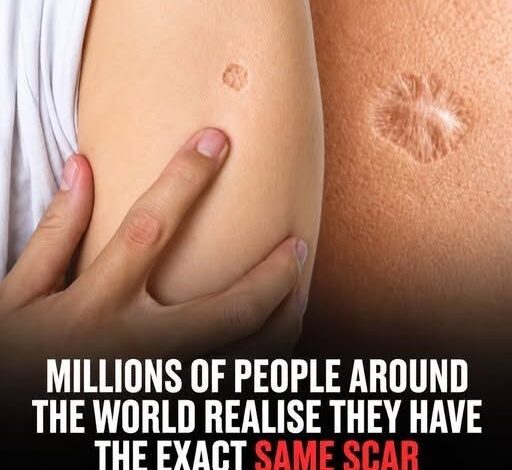
Have you ever looked at your upper arm and noticed a small, round scar that seems to have been there forever? If so, you are not alone. Millions of people around the world share an almost identical mark, and for years it has sparked curiosity, myths, and countless online discussions.
Many people first notice the scar during childhood or when comparing arms with friends and family. Surprisingly, individuals from different countries, cultures, and backgrounds often discover that they have nearly the exact same mark in the same location. This unusual similarity has led to many theories, ranging from genetic traits to mysterious childhood injuries.
The real explanation, however, is much less mysterious—and far more significant. In many cases, the scar is the result of a smallpox vaccination. Smallpox was once one of the deadliest diseases known to humanity. For centuries, it claimed millions of lives and left survivors with permanent scars and serious health complications.
During the twentieth century, governments and health organizations launched large-scale vaccination campaigns to protect populations from the disease. Unlike many modern vaccines, the smallpox vaccine was administered using a special technique that often left a visible scar after healing. The mark became a lasting reminder that the body had developed protection against one of history’s most feared illnesses.
The vaccination process was unique. Instead of a single injection, healthcare workers used a bifurcated needle to make several quick punctures in the skin. A small blister usually formed at the site before eventually healing into a circular scar. Because millions of people received the vaccine using the same method, many ended up with scars that looked remarkably alike.
For older generations, the scar became a common and almost unnoticed part of daily life. Yet younger people who were born after routine smallpox vaccinations ended often do not have the same mark. This difference has made the scar even more noticeable when family members compare their arms across generations.
The story behind the scar is closely tied to one of humanity’s greatest medical achievements. Through coordinated international vaccination efforts, smallpox became the first human disease to be completely eradicated. In 1980, the World Health Organization officially declared that the disease had been eliminated worldwide.
This accomplishment transformed global health and demonstrated the power of international cooperation in combating infectious diseases. The small scar carried by millions is therefore much more than a simple skin mark—it represents a historic victory over a devastating illness.
Despite this scientific explanation, the scar continues to generate fascination online. Social media users frequently post photos of their marks, asking others if they have the same one. Many are surprised to learn that a tiny scar can connect people from different continents through a shared piece of medical history.
Some individuals initially mistake the scar for a birthmark, while others assume it resulted from an injury they no longer remember. Once they learn the truth, many gain a new appreciation for the generations that participated in vaccination programs that helped protect entire communities.
Today, the small circular scar remains visible on the arms of millions of adults around the world. It serves as a quiet reminder of a time when a deadly disease threatened global populations and when science, medicine, and public health efforts came together to overcome that challenge.
What appears at first glance to be an ordinary skin mark is actually a symbol of resilience, innovation, and collective action. The next time you notice that familiar scar—or spot it on someone else’s arm—you may be looking at a small piece of history that helped change the world forever.