This Evening I Went Into My Girlfriends Bathroom and Found This on the Floor
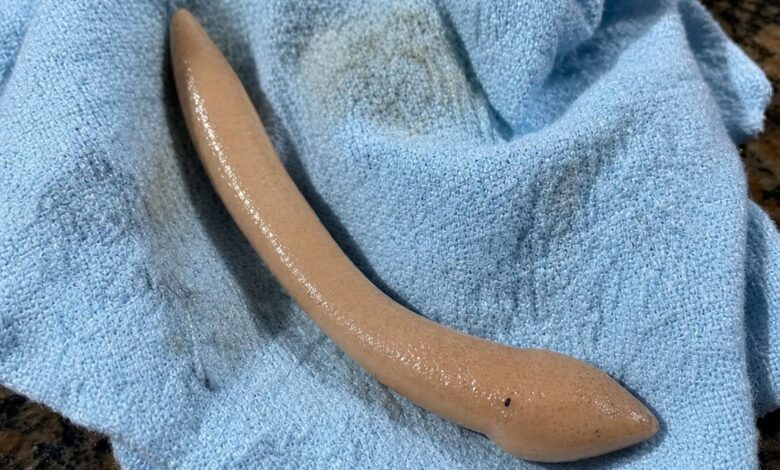
This evening, I went into my girlfriend’s bathroom and found something on the floor that stopped me in the doorway. It was pale, smooth, and curved, with a shape that looked halfway between a worm and a piece of rubber. At first I assumed it was some strange bathroom accessory. Then it moved.
I stayed there far longer than I want to admit. Every explanation that entered my mind was worse than the one before it. I looked at the sink, the shower drain, and the toilet. Nothing seemed disturbed. The thing lay on a blue cloth on the counter after I carefully lifted it, and its wet surface made it look even more unsettling.
I considered asking my girlfriend immediately, but embarrassment got the better of me. I did not want to accuse her of leaving something disgusting on the floor, and I definitely did not want to reveal how little I knew if the answer was obvious. So I took a photograph and tried to identify it first.
Online guesses arrived quickly. Some people called it a tapeworm. Others suggested a leech, a slug, or a piece of a silicone cosmetic product. A few warned that it might have come from a pet. The certainty of the replies was impressive, but the suggestions contradicted one another so completely that I ended up more confused than before.
The object’s broad, flattened body and pointed ends were the details that mattered. It was a land flatworm, a member of a group of soft bodied predators that sometimes wander indoors after heavy rain or travel unnoticed in potted plants. Their moist bodies can look rubbery, and some species are easily mistaken for slugs or pieces of animal tissue.
Flatworms need damp conditions, so a bathroom can temporarily suit one that enters through a gap, drain area, wet mat, or plant pot. Finding one does not mean it came from a person, and it is not evidence of a human intestinal parasite. Human tapeworm segments generally do not look like the long, broad creature in the photograph and would not normally crawl in from a garden.
That distinction was a relief, but it did not mean I should handle it with bare hands. Some invasive land flatworms produce irritating mucus, and cutting one into pieces is not a reliable way to kill it because certain species can regenerate. Identification can also be difficult from a single picture, so local guidance matters if the animal might be invasive.
I used gloves and placed it in a sealed container. The surrounding floor and cloth were cleaned, and I checked the bathroom for gaps, standing water, and recently moved plants. If the same type appears repeatedly, examining door seals, pipe openings, and plant soil would be more useful than pouring random chemicals down every drain.
The awkward conversation with my girlfriend turned out to be much easier than the half hour I spent inventing explanations. She had brought a potted plant into the bathroom earlier because its leaves needed washing. That gave the flatworm a likely route inside. She was as surprised as I was and laughed when I admitted I had been too embarrassed to ask.
The episode was a reminder that unfamiliar animals often look more frightening when seen outside their normal setting. A garden creature on soil might earn only a glance. The same creature on a bathroom floor can trigger thoughts of illness, infestation, and every horror story the internet can offer.
Once the animal was identified and removed safely, the mystery lost most of its power. The photograph still makes people gasp, but the answer was neither a secret bodily problem nor a creature emerging from the plumbing. It was simply a wandering flatworm that had taken the worst possible route through the house.