Police Came After a Mother Posted a Video of Her Husband Playing with Her Daughter
The older officer looked from Roger to me.
"Ma'am," he said, his voice breaking. "You have no idea what this man has done."
He was still standing in the hallway.
Barefoot. Gray T-shirt. Pajama pants.
The man who had braided my daughter's hair the night before now looked like someone waiting for a sentence.
"Roger?"
He swallowed.
The officer wiped at his eyes.
Then he did something I wasn't expecting.
Hard.
Roger froze.
Then wrapped both arms around him and started crying.
I just stood there.
"What is happening?"
The younger officer looked at me.
I blinked.
"What?"
The older officer pulled away from Roger.
His name tag said, MILLER.
He took a breath.
"Eight years ago."
Officer Miller continued.
"I was working undercover then."
My husband closed his eyes.
That was when I realized there was a part of Roger's life I knew almost nothing about.
My name is Rachel.
I was 32 then. Roger was 35.
Before him, I had spent a long time learning not to expect anyone to stay.
Winnie's biological father left while I was pregnant.
He told me he wasn't ready to be responsible for another person.
Apparently, I was.
I raised Winnie alone for two years.
I worked, paid daycare, skipped meals when money got tight, and pretended I wasn't scared.
He worked in our accounting department.
At first, he was just the man who noticed when I looked exhausted.
Coffee appeared on my desk.
Then breakfast.
Then little things for Winnie.
A sticker book, a stuffed rabbit.
A dinosaur Band-Aid kit because she'd gone through a phase where every invisible injury required medical attention.
The first time I invited him over, Winnie stared at him for ten minutes and then handed him a plastic teacup.
Roger drank imaginary tea like he'd trained for it.
After that, he was done.
Completely in love with her.
When she first called him Daddy, he cried in the kitchen.
He didn't tell me. I found him.
That sentence stayed with me.
So did the fact that he never once asked me to treat him like he was doing us some favor.
He became family slowly. Then completely.
And now two police officers were at my door because a video of him playing with Winnie had apparently solved something from eight years earlier.
I looked at Roger.
"You need to explain."
He nodded.
Roger looked at him.
Miller shook his head.
"You've carried enough of it."
That sentence made me nervous again.
I invited them inside.
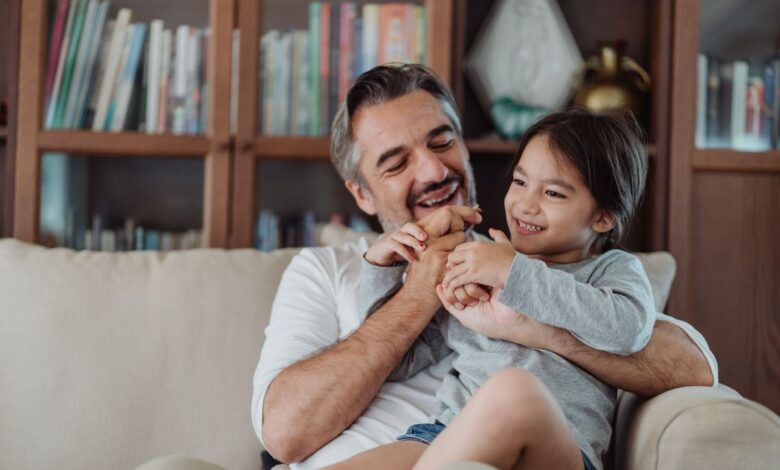
We sat in the living room where, less than 12 hours earlier, Roger had been spinning her around while she screamed with laughter.
Now he sat with both hands clasped between his knees.
Officer Miller took off his cap.
"Eight years ago, I was shot."
I looked at Roger. He didn't move.
Miller continued.
I knew almost nothing about police work.
But I understood enough to know how serious that was.
Miller said he and another officer were following a suspect into an old industrial area on the edge of the city.
Something went wrong.
The suspect realized who they were.
There was a confrontation. Shots were fired.
His partner went after the suspect.
Miller collapsed behind a warehouse.
And then Roger found him.
I stared.
Roger finally spoke.
"I was working nearby."
He hesitated.
"Construction cleanup."
That surprised me.
Roger had been an accountant for as long as I'd known him.
Officer Miller said, "He heard the shots."
Roger looked embarrassed.
"I almost left."
"You keep saying that like it matters."
"It does."
"No. What matters is what you did next."
I looked between them.
"What did he do?"
Miller's face changed.
Apparently, Roger found Miller badly injured behind a concrete barrier.
Miller was barely conscious.
His radio had been damaged.
His phone was somewhere he'd dropped it.
Roger called 911.
Then he stayed.
When Miller started losing consciousness, Roger kept talking to him.
Kept asking questions.
Name. Family. Anything.
Miller said, "I kept telling him to leave."
"Why?"
"Because we didn't know whether the shooter was still nearby."
"You stayed?"
He shrugged.
"I wasn't going to leave him there."
Miller laughed softly.
"He said that then too."
My throat tightened.
The younger officer, Officer Patel, spoke again.
"Officer. Miller says your husband probably kept him alive long enough for EMS to get there."
Probably.
I hated that word and loved it at the same time.
"Why have you never told me this?"
Miller answered.
"Because he disappeared."
I frowned.
"What do you mean?"
Miller leaned back.
"By the time I woke up after surgery, nobody knew who he was."
"He called 911."
"From a prepaid phone."
Roger looked even more uncomfortable.
I turned toward him.
"Roger."
He exhaled.
That was the first time I'd ever heard him say it like that.
I knew he had grown up poor.
I knew his mother died when he was 19.
I knew he put himself through community college later than most people.
But the years before that? He didn't talk about them.
Now I knew why.
He drifted between jobs, slept some nights on a friend's couch and other nights in a work van.
He had a suspended license from unpaid tickets.
A couple of misdemeanor charges from his early 20s.
Nothing violent. Nothing major.
But enough to make him think police attention was the last thing he needed.
I said, "So you saved an officer and then ran because you were afraid you'd get arrested?"
"Basically."
Officer Miller said, "He didn't run immediately."
I looked at him.
"He stayed until EMS arrived. Then when they started asking questions, he gave a first name and left."
"Yes."
Miller smiled faintly.
"At least that part."
Then he explained why they never found him.
The area had terrible cameras.
No clear license plate.
He had been hired through a subcontractor that shut down a few months later.
His first name was common.
The phone number from the 911 call went dead.
Miller spent years trying to identify him.
Not because Roger was a suspect.
Because Miller wanted to thank him.
"You never knew?"
Roger shook his head.
"I assumed he survived."
Miller stared at him.
"Assumed?"
Roger finally looked at him.
"That is not the same thing."
"I didn't know how to find out."
"You could have called the department."
Roger gave him a look.
Miller sighed.
"Right. Suspended license. Warrants for unpaid tickets."
I covered my mouth.
The whole thing was so ridiculous and so deeply sad.
Then I asked the obvious question.
"How did my Facebook video lead you here?"
Officer Patel smiled.
"Officer. Miller saw it."
"How?"
"Your original post was tagged with Roger's name. Once I knew who he was, I was able to find your address. Officer Patel offered to come with me because I wasn't sure how I'd handle seeing Roger again."
The video had gotten more attention than I expected.
A local parenting page shared it.
Then another account did.
Apparently, someone who knew Officer Miller shared it in a community group.
He was scrolling. Then he saw the video.
Roger laughing, turning toward the camera.
Just for a second.
Miller said, "I knew his face."
"After eight years?"
"I'd been trying to remember it for eight years."
Roger looked stunned.
"Mostly I remembered his voice. But when he turned in that video, I knew it was him."
He took out his phone.
Then showed me something.
An old police composite.
Shorter hair. Thinner face.
But it was Roger.
I stared at it.
"You had a sketch?"
Miller nodded.
"I gave a description from memory after I recovered."
"You made my nose too big."
"You are criticizing the sketch?"
"A little."
For the first time, all four of us laughed.
Then Winnie called from upstairs.
I stood automatically.
Roger did too.
"Stay," I said.
He looked at me.
"Rachel—"
"I've got her."
Winnie was sitting in bed with her hair everywhere.
"Who's here?"
"Some police officers."
Her eyes widened.
"Did Daddy get arrested?"
I almost laughed.
"Did you?"
"No."
"Then why?"
"Because Daddy helped someone a long time ago."
She considered that.
"Like a superhero?"
"Kind of."
She immediately wanted to see.
I carried her downstairs.
The second she saw the uniforms, she hid her face in my neck.
Officer Miller smiled.
"Hi."
Roger said, "It's okay, bug."
She reached for him.
He took her.
Miller watched.
Then his eyes filled again.
He said, "Is this your daughter?"
"Yeah."
There was something in his voice when he said it.
"She's lucky."
Roger swallowed.
"So am I."
Then Miller reached into his pocket.
"I actually brought something."
He pulled out an old photograph.
Hospital room.
Miller looked younger.
Pale. Bandages everywhere.
"My daughter," he said.
"She was born three weeks after I got shot."
He looked at Roger.
"I would've missed her."
Roger's face changed completely.
On the back, someone had written: Emma meeting Dad.
Roger stared at it.
Miller said, "She's eight now."
Roger closed his eyes.
That did it.
He started crying.
He sat there holding my four-year-old daughter and a photograph of another little girl whose father he'd unknowingly helped keep alive.
I took Winnie from him.
Miller crouched in front of Roger.
"I have wanted to say this for eight years."
Roger wiped his face.
"You don't owe me anything."
"That's not how gratitude works."
Then he said, "Thank you."
Roger looked away.
"You didn't know me. You didn't know whether the shooter was still there. You didn't know whether I was going to live. You stayed anyway."
Roger's voice cracked.
Miller leaned closer.
"You were there, and then you chose."
Because that was Roger.
He had spent years minimizing everything good he'd ever done.
Later, after the officers left, I asked him why.
Not why he saved Miller.
Why he never told me.
Roger sat at the kitchen table.
"I was ashamed."
"Of what?"
"You were broke."
"More than broke."
He looked down.
"I was angry all the time. Drinking too much. Getting into trouble. I thought my life was going nowhere."
"But you saved someone."
"One good thing doesn't erase everything else."
He looked surprised.
I continued.
"But everything else doesn't erase the good thing either."
He was quiet.
Then he told me something else.
The day after the shooting, he'd gone back to the warehouse.
The job supervisor told everyone a cop had almost died nearby.
Roger heard that and panicked.
He quit.
Within months, he left the city.
Before leaving, he paid his outstanding fines and resolved his legal troubles.
Stayed with a cousin, stopped drinking, and finished community college.
I asked, "Was the shooting why?"
He thought about it.
"Partly."
"What changed?"
He stared at his hands.
I remember sitting beside that guy and wondering if he was going to make it.
"And I realized if I died then, nobody would've had a very good story to tell about me."
That hurt.
"So you changed your life?"
"I tried."
I thought about the man who brought me coffee.
The man who knew Winnie's stuffed animals by name.
"You did more than try."
He smiled faintly.
Then I asked, "Why did Officer Miller say, 'You have no idea what he's done' like you were a serial killer?"
Roger laughed so hard he had to cover his face.
"That was dramatic."
"Extremely."
"Is that an excuse?"
"Apparently."
I laughed too.
But the story didn't end that morning.
Officer Miller came back a few weeks later.
This time with his wife, Grace, and their daughter, Emma.
Shy. Carrying a soccer ball.
Winnie decided within five minutes that Emma was her new best friend.
Children do that.
Adults spend years building trust.
Kids exchange one sticker and announce lifelong loyalty.
Grace hugged Roger.
She said, "I've wanted to meet him for years."
Roger looked uncomfortable.
Grace noticed.
"So I'm going to say this once and then I'll stop making you squirm."
He smiled.
She said, "Thank you for giving my daughter her father."
Then she kept her promise and changed the subject.
They stayed for dinner.
It became a strange kind of friendship after that.
Not constant. Not sentimental every week.
But real.
Birthday messages. Cookouts. Christmas cards.
Roger still complains about the composite sketch.
Last year, Miller gave him a framed copy for Christmas.
Underneath, he'd written, "WANTED: For excessive humility and one terrible haircut."
Roger put it in his office.
I still have the original Facebook video too.
I almost deleted it after everything happened.
But Winnie loves it. She's six now.
Sometimes she watches herself spinning in Roger's arms and says, "I was so little."
Then she asks, "Is this the video that found Daddy?"
That's what she calls it.
The video that found Daddy.
Technically, it found a man who had spent eight years looking for him.
For most of my life, I thought people's pasts worked like labels.
Good father. Bad father.
Good man. Bad man.
Then life kept proving that people are messier than that.
Winnie's biological father left before she was born.
Roger wasn't biologically responsible for her at all, but he stayed.
Then one night, he ran toward gunfire because a stranger needed help.
He didn't become a good man that night.
Life isn't that simple.
But he made one good choice.
Then another.
Years later, he made coffee for an exhausted single mother.
Then he married us.
And one ordinary evening, I posted a video because I thought the sweetest thing about Roger was the way he loved my daughter.
The next morning, I learned someone else had been grateful for him much longer than I had.
Officer Miller was right about one thing.
I had no idea what my husband had done.
But after I learned, what mattered most wasn't that he'd once saved a police officer.
It was that eight years later, when nobody was watching, and no one was keeping score, he was still the kind of man who stayed.
Do you think Roger's decision to save Officer Miller despite his fear of getting arrested revealed who he truly was, even before he turned his life around?
If Roger's story touched your heart, here's another that will keep you hooked. A mother watched her 14-year-old daughter cry herself to sleep every night because of her acne. But when she opened the girl's makeup bag, she discovered something that made her rush straight to school. Click here to read the full story.